|
B-TOP
|
Bloomington Transportation Options for People
Presentations2012 Livable Cities SeriesSticky Community Design: A Path to Economic, Environmental and Public HealthMark Fenton, "America's Walking Guru" Mark explained to us how we can engineer physical activity back into American communities and lives. He showed us how the lack of unstructured physical activity is leading to a national health crisis in terms of a diabetes epidemic that is spreading to our children. He then explained mindsets and policies that got us into this situation by providing subsidies which incentivize inactive transportation. He suggested that we need to pressure our elected officials, and that we specifically need a multidisciplinary committee that would foster interaction between community organizations such as schools and the YMCA and city departments such as planning and engineering. In addition, Mark has got to be the tenth person we brought to Bloomington who observed that we have too many one-way urban highways running through the core of our city. 2011 Livable Cities SeriesSuzanne MittenthalDirector of Hoosier Hikers Council Suzanne Mittenthal, the Director of the Hoosier Hikers Council, spoke to us about the tasks involved in changing a grand vision into a reality. The HHC is working to complete the Knobstone Trail, a 150-mile hiking route from Louisville to Indianapolis. She related several stories about how she convinced land-owners to allow the Knobstone Trail to pass through their properties. We need to learn from her lessons in order to be effective at impacting urban planners. (event flyer) Creating a Bike-Friendly City: Lessons from PortlandMia Birk,
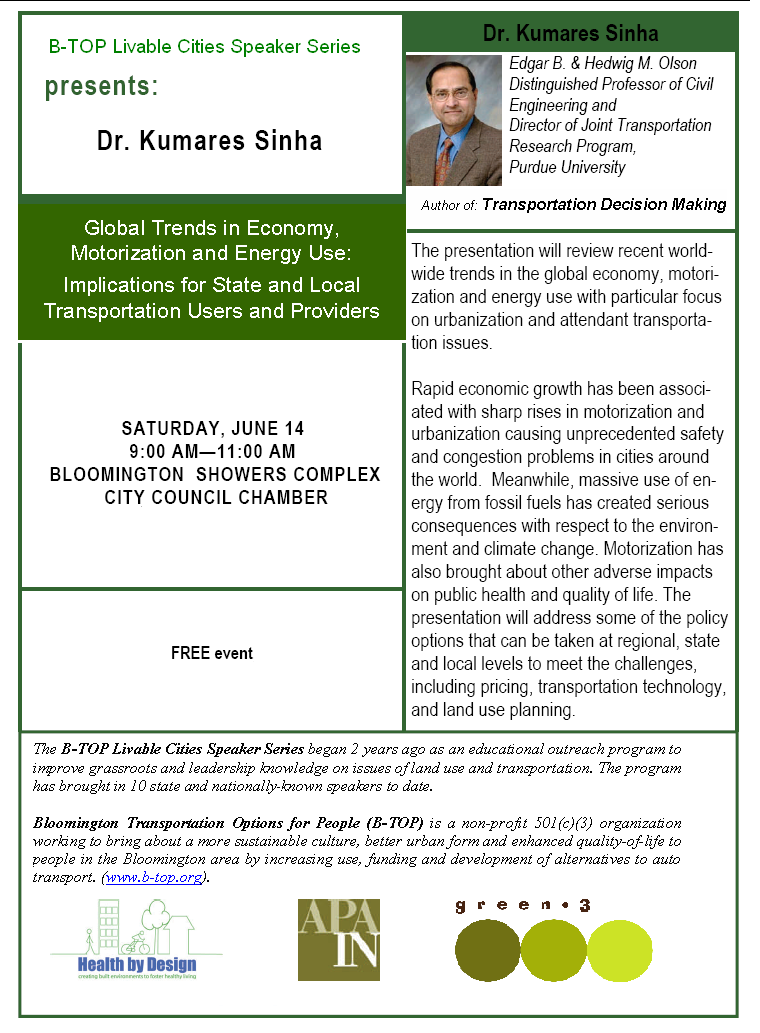
author of Joyride: Pedaling Toward a Healthier Planet Portland now sees over 20,000 bikes crossing its bridges every day; in 1991, that number was only 2500. Mia Birk is considered the mother of Portland's bike-friendly culture. She was the Portland Bike Program Manager during a time of real bike-infrastructure improvements (1993-1999). Since then, she has consulted all over the nation on bike infrastructure and programs with her consulting firm Alta Planning + Design. (event flyer) 2010 Livable Cities SeriesEffective Public Transit in a University TownMarty Sennett, general manager of the Greater Lafayette Public Transit Corporation Marty Sennett is the general manager of the Greater Lafayette Public Transit Corporation (CityBus) and President of the Indiana Transportation Association. He showed us some of the things that Lafayette and Purdue have done to enhance bus service for students and residents there. He will also explain how some of these techniques could work here, since we are in a similar situation. He is speaking in room 125 of the IU Law School Building (211 S Indiana Ave) on Thursday April 8 at 7:30 p.m. (event flyer) 2009 Livable Cities Series"A vision of low-carbon, human-centered transportation"Kevin Whited, Transportation Planner Kevin Whited has worked as an alternative transportation planner and a promoter of transportation demand management programs in Indianapolis and Atlanta--cities not known for being friendly to cyclists, walkers, and transit riders. But this past summer, while working on an internal sustainability plan for the Oregon Department of Transportation, he saw what communities can be like when transportation is human-centered instead of car-centered. Come hear about what we're missing here in Bloomington--and how we can remake our infrastructure to move people, not cars. 2008 Livable Cities SeriesGlobal Trends in Economy, Motorization and Energy Use: Implications for State and Local Transportation Users and Providers
Dr. Kumares Sinha, Director of
Joint Transportation Program
at Purdue University and author of Transportation Decision Making Rapid economic growth has been associated with sharp rises in motorization and urbanization causing unprecedented safety and congestion problems in cities around the world. Meanwhile, massive use of energy from fossil fuels has created serious environmental consequences. Motorization has also brought about other adverse impacts on public health and quality of life. The presentation addressed some of the policy options that can be taken at regional, state, and local levels to meet the challenges, including pricing, transportation technology, and land use planning. Sponsors included: Health by Design, APA IN, and green 3. Click here for the event flyer. Smart Growth WorkshopRobert McCormick, director of Planning with Power at Purdue University A PowerPoint presentation and workshop that introduced the 10 principles of smart growth. He explained how smart growth is connected to a community's natural resources, water quality, transportation, economic development, and, ultimately, the quality of life. The workshop was sponsored by Illinois-Indiana Sea Grant College Program, Planning with Power, and Purdue Land Use Team. Click here for the event flyer. Walkable CommunitiesDan Burden, executive director of
Walkable Communities and principal of
Glatting Jackson Kercher Anglin of Orlando Bloomington Transportation Options for People and Council of Neighborhood Assocations of Monroe County presented a workshop featuring Dan Burden. Dan Burden is a nationally recognized authority on bicycle and pedestrian facilities and programs, street corridor and intersection design, traffic flow and calming, and other design and planning elements that affect roadway environments. He has had 25 years of experience in developing, promoting and evaluating alternative transportation facilities, traffic calming practices and sustainable community design. Event flyer 2007 Livable Cities SeriesDr. Robert CerveroDr. Robert Cervero,
Professor of City and Regional Planning at UC Berkeley. Dr. Cervero is widely considered the leading expert on urban mass transportation. He is the author of 6 books on the subject including: The Transit Metropolis, Developing Around Transit, and Transit Oriented Development in the United States. He is the recipient of the Dale Prize for Excellence in Urban Planning Research and the 2003 Article of the Year from the Journal of the American Planning Association. Event flyer. Dom NozziDom Nozzi, Executive
Director of Walkable Streets Mr. Nozzi is the author of the book Road to Ruin; has worked as senior planner and urban designer for the city of Gainesville, Florida for the past 20 years; and has given nationwide presentations on the topics of sprawl, walkable streets, and general urban design. His extensive work is documented at his website, www.walkablestreets.com. Street Design, Transportation Planning and Community LivabilityDr. Norman Garrick, Professor of Civil Engineering, University of Connecticut Dr. Garrick has been involved in the creation and review of the new draft design guidelines for the Institute of Transportation Engineers (ITE): Context Sensitive Solutions in Designing Major Urban Thoroughfares for Walkable Communities. This highly-acclaimed document is a significant paradigm shift from general street planning practices, proposing more walkkable and livable street design. It is being considered for adoption by the ITE this spring. 2006 Urban Planning Scholar SeriesPortland Transportation and Traffic Safety InitiativesGreg Raisman,
Portland
Office of Transportation Greg Raisman presented some of the factors that have been considered in making Portland's infrastructure safer and more inviting for all users. The extensive use of statistics allows transportation planners to identify which locations and habits are most dangerous and focus their attention on them. Then a remedy may be implemented such as traffic calming or a bicycle boulevard. Laws that Create SprawlMichael Lewyn, Professor of Law at Florida Coastal School of Law City ordinances are the legal constructs that ultimately dictate urban form and solve urban problems. Professor Lewyn has focused his work on the laws that create and reduce sprawl, control transportation choices and affect social equity. He shows that many common laws serve to increase sprawl to the detriment of all parties. Midwest High Speed Rail PlanCristine Klika, Executive Director of
Indiana High Speed Rail Association The Indiana High Speed Rail Association is a Non-Governmental Organization that is helping promote a $7.7 Billion, 9-State Midwest High Speed Rail Plan. The plan calls for 110 mph trains and a feeder bus system serving over 200 Midwestern cities. Urban Planning, Transportation, and Public HealthDr.
Lawrence Frank of University of British Columbia Our current urban development practices affect our transportation choices and our level -- or lack -- of physical activity, contributing to poor air quality, obesity and other ill health effects. Dr. Frank discussed the interaction between land use, urban form, travel choice, and public health. Urban Parking Policy - The Economic, Social, and Environmental EffectsDr. Donald Shoup, Professor of Urban Planning at UCLA Donald Shoup is the author of "The High Cost of Free Parking" (2005). He discussed who bears the costs of parking and made suggestions for more equitable policies that result in better transportation choices. |